
What is a Drop Deck Trailer? Your Complete Australian Guide
A drop deck trailer is a semi-trailer with two deck levels: a higher front section and a lower drop deck. The step down between those two levels is the whole point: it lets you carry taller freight while keeping the top of your load under the 4.3m general access height limit.
The front deck sits at roughly 1,500mm above the ground on 19.5-inch axles. The lower drop deck sits at around 1,020mm on the same axle specification. That 480mm difference can be the gap between moving a machine on general access and applying for an oversize permit, which means delays, extra costs, and route restrictions.
Drop decks are common in earthmoving, civil construction, agriculture, and any industry that regularly moves tall or heavy plant. If your loads are consistently pushing against the height limit, a drop deck is usually the most practical answer before you start looking at PBS or oversize permits.
Height advantage in practice. The lower drop deck sits roughly 480mm lower than the top deck: 1,020mm versus 1,500mm on 19.5-inch axles. At the 4.3m general access height limit, that's the difference between loading a tall excavator without a permit versus needing one. For operators moving earthmoving equipment regularly, that gap is worth a great deal.
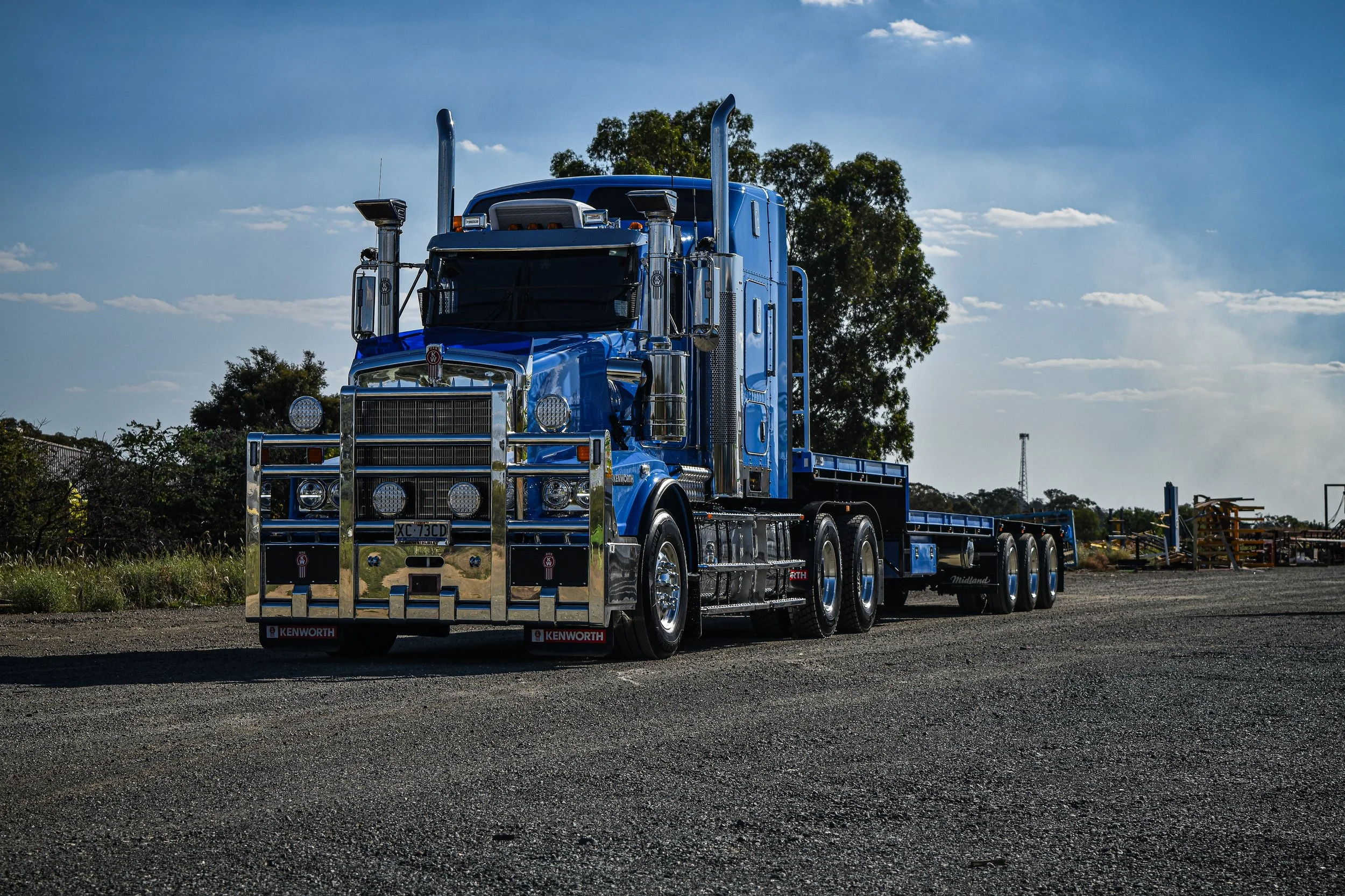
What Makes a Drop Deck Trailer Different
The front section of a drop deck, sometimes called the top deck or gooseneck, connects to the prime mover's fifth wheel and sits at the same height as a standard semi-trailer deck, around 1,500mm from the ground on 19.5-inch axles. Behind that, the trailer steps down into the lower drop deck, which sits at around 1,000mm depending on tyre size.
That step is what gives the trailer its name and its value. The lower the deck, the taller the load you can carry under the legal height limit without a permit.
Compare that with a flat top: a flat top trailer runs a consistent deck height across its full length. That's fine for most freight: steel, timber, plant that isn't too tall. But once your load pushes past about 3.4m in height, a flat top starts putting you close to or over the 4.3m limit, depending on what tyres and suspension configuration you're running. A drop deck gives you back that headroom by putting the freight lower to the ground.
Loading a drop deck is straightforward for mobile machinery. The trailer is typically fitted with rear ramps, either a fixed lower rear section or removable alloy ramps, allowing plant to be driven straight on from the rear. The deck is 2.5m wide from front to rear across the full length of the trailer.
Australian Dimensions and Mass Limits
Drop decks run under the same national access rules as other semi-trailers. From 1 August 2026, the NHVR's Mass Dimension and Loading (MDL) reforms update several mass limits.
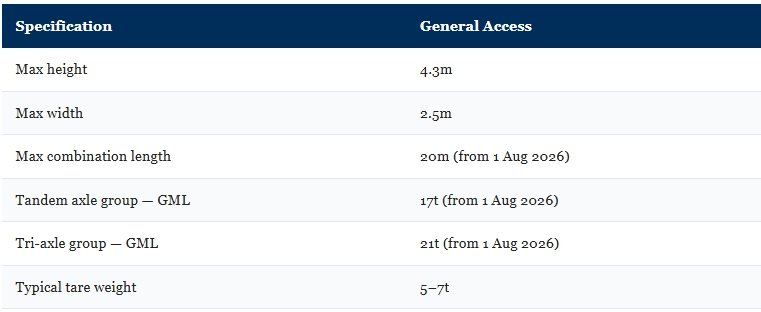
The August 2026 changes bring triaxle GML up from 20t to 21t, which is meaningful for operators hauling heavier plant. The tandem axle GML of 17t stays the same under general access but is now confirmed in the updated MDL rules. If you're running under Higher Mass Limits (HML) or PBS accreditation, different figures apply; talk to your accreditation body or trailer manufacturer about what your combination can carry.
Drop Deck Trailer Configurations
Most drop decks in Australian fleet use fall into a few common configurations.
Tandem axle: two axles at the rear. These are lighter trailers. With a GML of 17t and a typical tare of 4-5t, payload on general access sits around 20-24t. They're simpler to maintain and easier to manoeuvre, which makes them popular for operators who move mid-weight plant between construction sites.
Tri-axle: three rear axles. The extra axle spreads the load across more road surface and pushes the GML up to 21t under the new rules, with payload on general access reaching up to 28t depending on tare. This is the more common choice when you're moving heavier earthmoving equipment: excavators above 15t operating weight, large rollers, or heavy machinery that would otherwise require a permit.
Double drop deck: Midland also builds a double drop deck configuration. This design features a centre well with a deck height of around 700mm, suited to carrying oversize tyres, large diameter items, and similar freight that benefits from an even lower carrying position. These are built to order for specific applications.
Well lengths vary by application. Common well lengths are 12m, 13.5m, and 14.5m, though custom lengths are built to suit specific freight. If you're regularly moving a particular machine, say a specific excavator model, it's worth knowing its footprint before you specify well length.
What Do People Use Drop Deck Trailers For?
The drop deck is a versatile, all-round trailer. It handles machinery and plant as well as general freight: hay, equipment, building materials, and loads that don't need a specialised configuration. Many operators run a drop deck as their default trailer precisely because it covers such a wide range of jobs.
Earthmoving equipment is the most common use case. Excavators, graders, compactors, and skid steers all sit in height ranges where the lower deck means the difference between general access and a permit. Most operators moving plant between civil construction sites run drop decks because the permit process eats too much time and money to justify on regular moves.
Agricultural machinery is another steady use case. Headers, tractors with cab extensions, and large sprayers often have tall profiles. Hay, baled or stacked, is a common general freight use. The flat, unobstructed deck area suits large hay loads that need a stable, low platform.
Modular building sections and prefabricated structures are increasingly common on drop decks as the modular construction sector grows. And on the fabrication side, tall steel sections, large tanks, and industrial machinery all find their way onto drop deck wells when height is the limiting factor.
For general freight where height isn't a constraint, the drop deck still performs well as an all-round platform. Operators who want one trailer to handle both machinery moves and general haulage often find the drop deck covers both without compromise.
Midland's Drop Deck Trailers
Midland Pty Ltd builds drop deck trailers at its manufacturing facilities in Parkes NSW and Kyneton VIC. Both sites produce trailers for the Australian market, covering the full range of open-top trailer types including drop decks.
Midland's Tow and Go range covers drop decks for operators who need a proven, Australian-finished trailer ready to work. These trailers use frames sourced offshore with all fit-out and finishing done in Midland's Australian factory, a practical option when you need a reliable trailer without a custom build lead time.
For operators with specific requirements (a particular well length, a non-standard axle configuration, specific deck material or load-securing arrangement), Midland builds custom engineered trailers from the ground up to your specs. These are 100% Australian-made and engineered to match the freight, not the other way around. If you're moving the same type of load day in, day out, a trailer spec'd around that task will outperform a standard configuration.
Midland's approach is direct: tell us what you're moving, how often, and what roads you're running, and we'll tell you what configuration makes sense. Move More With Certainty.
How to Choose the Right Drop Deck Trailer
Before you talk to any manufacturer, get clear on a few things.
What's the tallest item you're moving regularly? Measure it. The height of your most frequent load determines whether you need a drop deck at all, and whether a standard well depth is enough or you need something deeper.
What payload do you need? A tandem axle configuration gives you a lighter trailer and simpler operation, but caps your GML at 17t under general access. If your loads regularly exceed that, you're looking at tri-axle or HML accreditation.
How long does your freight need to be? A 12m well covers most plant. But if you're regularly carrying 13m or 14m items, your well length needs to match. Getting this wrong means either your freight overhangs or you're applying for permits on every run.
Will you need to go HML or PBS? If your payloads are consistently heavy, beyond what general access allows, it's worth planning your accreditation path before you order a trailer. The trailer spec and your accreditation need to work together.
Are you running a B-double? The rear trailer of a B-double can be a drop deck. If you're running doubles and need height clearance on the rear, a drop deck B-trailer is an option worth discussing. See our flat top guide for more on how deck heights work across B-double configurations.
Frequently Asked Questions
What's the difference between a drop deck and a flat top trailer?
A flat top has a single deck height across its full length. A drop deck has a higher front section and a lower rear well. The lower well lets you carry taller freight without exceeding the 4.3m height limit. If your freight is under about 3.4m tall, a flat top is usually the simpler, more practical option. Once your loads push higher than that, a drop deck starts making sense. See our flat top trailer guide for a full comparison.
How much extra height clearance does a drop deck give?
The lower drop deck sits roughly 480mm lower than the top deck: 1,020mm versus 1,500mm on 19.5-inch axles. In practice, that means you can carry freight up to about 3.28m tall within the 4.3m limit, compared to roughly 2.8m at the higher deck height. The exact figure depends on your trailer's build, suspension, and tyre size. Measure your actual trailer before making load decisions.
What axle configurations are available?
Most drop decks run either tandem (two) or tri-axle (three) rear axle groups. Tandem suits lighter payloads and is more manoeuvrable. Tri-axle spreads the load and allows higher GML under general access. For specialist or very heavy applications, additional axle options exist but typically require PBS approval.
What's the GML for a drop deck trailer in Australia?
Under general access from 1 August 2026: tandem axle group 17t, tri-axle group 21t. These are the same limits that apply across semi-trailers generally, the drop deck configuration doesn't change the mass rules. If you're running under HML accreditation, the limits are higher: check NHVR's current HML schedule for your state and combination type.
What's the heaviest load I can carry on a drop deck?
On general access with a tri-axle drop deck, payload can reach up to 28t depending on configuration and tare. A tandem axle configuration delivers around 20-24t. HML accreditation pushes those figures higher. For very heavy plant, anything above 20-25t operating weight, you're likely looking at HML, PBS, or an oversize/overmass permit.
Do I need a permit to run a drop deck trailer?
Not if you're within general access limits: standard height (4.3m), width (2.5m), length (20m), and mass. A drop deck used within those limits runs without a permit. Permits come into play when your load exceeds any of those dimensions, or when your mass exceeds the GML for your axle configuration. The trailer itself doesn't trigger permit requirements; your load and combination do.
Can a drop deck trailer run as a B-double?
Yes. A drop deck can be configured as the B-trailer (rear trailer) in a B-double combination. This is useful when you need the height clearance benefit on a longer combination. The front trailer in a B-double is typically a flat top or drop deck as well, depending on the freight. B-double combinations have their own dimension and mass rules under NHVR regulations.
What types of freight shouldn't go on a drop deck?
Drop decks aren't ideal for freight that needs a fully flat, consistent deck surface from end to end. The step between the front section and the well can be a complication for palletised goods, steel coil, or any freight that needs to be positioned or shifted along the full deck length. For that kind of freight, a flat top is the cleaner choice. Drop decks also aren't suited to freight that's too wide for the well, some well widths are narrower than a standard flat top, so check before you load.
What's a double drop deck and when do I need one?
A double drop deck adds a centre well with a deck height of around 700mm, lower again than a standard drop deck's 1,020mm. It suits freight that benefits from an even lower carrying position: oversize tyres, large diameter items, and similar loads. These are built to order for specific applications rather than run as standard fleet trailers.
How does a drop deck trailer differ from a low loader?
A low loader (also called a float) has its deck set very close to the ground across its full length, rather than having a front section at road height. Low loaders are designed specifically for very heavy or very tall plant where even a drop deck well isn't low enough. They typically require PBS approval or oversize/over mass permits due to their configuration and the loads they carry. A drop deck is a general-fleet trailer running under normal road access rules. A low loader is a specialist machine. If a drop deck can do the job within general access limits, it's the simpler and cheaper path.
Talk to Midland
If you're trying to work out whether a drop deck is right for your operation, or which configuration makes sense for the freight you're moving, Midland's team can help you work through it. We build both standard and custom drop decks at our Parkes and Kyneton facilities. Tell us what you're carrying and we'll tell you what we'd build.