
What is a Dog Trailer? Your Complete Australian Guide
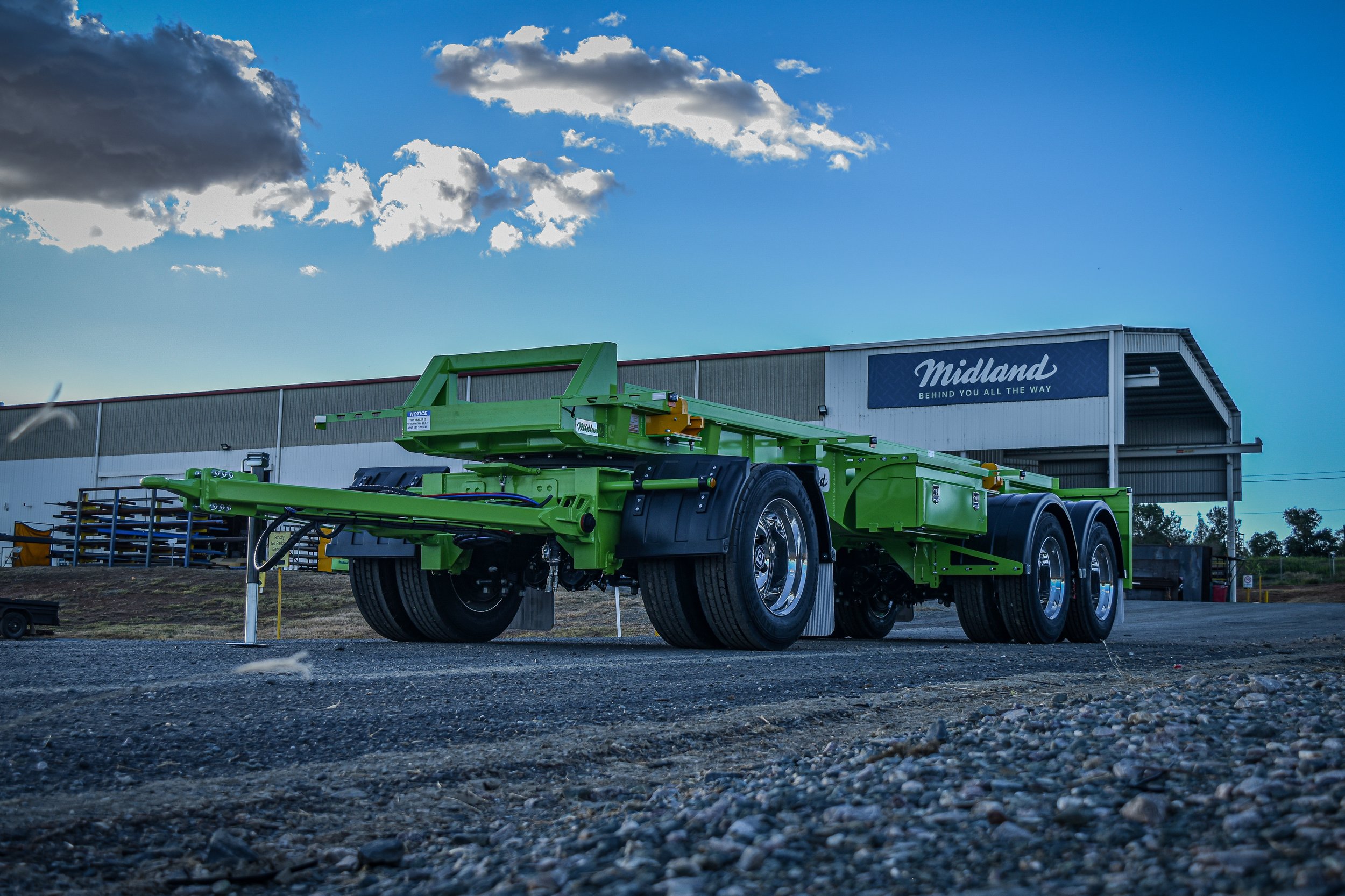
A dog trailer is a drawbar trailer with both a front and a rear axle group. That front axle group is what sets it apart. It sits on a turntable and steers as the drawbar swings left or right, so as the towing vehicle turns, the front of the dog trailer follows. The platform rides between the two axle groups, and the whole thing tracks predictably through bends.
The name comes from that tracking behaviour. A dog trailer follows the lead vehicle the way a dog follows its owner, consistently and in line. It connects via a drawbar coupling to the rear of a prime mover, semi-trailer, or rigid truck. That coupling is not a fifth wheel, it's a pin or ring connection at the drawbar eye.
Dog trailers are most commonly used in metropolitan and tight work environments, construction sites, road works, earthmoving projects, where the tow vehicle needs to move freely between tasks. The dog trailer can stay on site, loaded or being loaded, while the rigid truck heads out to cart or remove material from the project. That flexibility is the practical reason crews choose a dog trailer over other configurations.
A key advantage of the dog trailer in construction and earthmoving work is the ability to run loaded in both directions. The truck delivers material to site on the way in, and removes spoil or waste on the way out. For short-haul runs where the vehicle is required continuously at the project, that's the difference between two trips and one.
How a Dog Trailer Works
The front axle group on a dog trailer sits on a turntable, a circular pivot plate mounted below the front of the trailer chassis. The drawbar connects the turntable to the rear of the lead vehicle. When the lead vehicle turns, the drawbar swings, the turntable rotates, and the front axle steers to match. The rear axle group is fixed.
This is what makes a dog trailer different from a rigid drawbar trailer. A rigid drawbar forces the front of the trailer to follow a fixed arc, which causes problems on tight corners and short roads. The turntable steering on a dog trailer gives it a swept path that's much closer to the lead vehicle's path, which is why dog trailers work well in metro and construction environments where space is limited and tight turns are common.
The platform sits between the two axle groups, so freight is supported at both ends. Load distribution across the axle groups is something you plan before you load, getting the weight split right matters for both legal compliance and tyre wear.
A tag trailer works differently. A tag trailer connects to the rear of a rigid or body truck via a fixed drawbar and hitch. That connection transfers mass from the trailer onto the rear axle of the truck, which means the operator can run the truck without needing a full bin load or ballast weight to keep drive axle weights legal. It's a useful configuration when the truck itself is being used for carting or tipping work and the trailer needs to complement that. If you're comparing your options, the tag trailer guide covers the differences in full.
A semi-trailer is different again. A semi couples at the front via a kingpin that drops onto the prime mover's fifth wheel. The prime mover carries roughly half the semi's load through that coupling. A dog trailer carries its own weight front and rear through its own axle groups, the towing vehicle only feels the drawbar pull, not the vertical load.
Australian Mass Limits
Mass limits for dog trailers depend on axle group configuration and the access level of the roads you run. The table below covers the main numbers under General Mass Limits (GML) and Heavy Mass Limits (HML). Note that GML axle group limits change effective 1 August 2026.
SpecificationValueMax height (general access)4.3 mMax width (general access)2.5 mTandem axle group, GML (from 1 Aug 2026)17 tTri-axle group, GML (from 1 Aug 2026)21 tTri-axle group, HML22.5 tTypical dog trailer tare weight5-7 t
The August 2026 GML changes are worth noting specifically. The tri-axle group limit increases from 20 t to 21 t under GML, an extra tonne per tri-axle group on general access roads without HML approval. If you've been calculating payloads based on the old 20 t limit, it's worth updating those numbers.
A dog trailer with a tandem front axle group and tandem rear axle group has two rated axle groups. Under GML from August 2026, each tandem group is rated at 17 t, giving you 34 t across both groups before tare. At a typical tare of 6 t, that's around 28 t of payload on the dog alone, though the combination's overall gross mass limit (set by the total of all axle groups plus the prime mover's steer and drive axles) is what you'll usually hit first.
HML access unlocks higher limits per axle group, but requires the roads you're running on to be approved for HML. PBS (Performance-Based Standards) can take you further again if the combination's performance meets the relevant standards, useful for operators making regular runs on specific routes.
Dog Trailer Configurations
The most common configuration for open-top freight is tandem front, tandem rear. Both axle groups are two-axle groups, the deck is a flat open platform, and it suits most general freight, building materials, steel, agricultural inputs, equipment.
Tri-axle rear configurations are used where the freight type or payload target needs more rear axle capacity. Moving from a tandem to a tri-axle rear adds another axle group mass rating, which lifts what you can legally carry on that end of the trailer. The trade-off is weight, the extra axle adds tare, and on some routes the additional axle configuration affects PBS or road access classification.
Deck length varies by freight type. Longer decks suit longer items, steel sections, pipes, machinery, but increase the swept path through tight turns. Shorter decks are easier to manoeuvre and can work better where the loading or unloading area is tight.
Platform types are mostly flat top for general freight. Drop deck configurations are available for freight where the height needs to stay under 4.3 m, machinery with tall profiles, for example. The drop deck guide has more detail on when a drop deck makes sense over a flat top.
What Do People Use Dog Trailers For?
Road construction and civil works crews are among the most common users. On a road works project, the dog trailer carries construction material, aggregate, asphalt, base course, pipes, steel, to the job, then comes back loaded with spoil, waste, or removed material. Running loaded in both directions maximises what the combination achieves on every trip. The dog trailer can stay at the site while the rigid truck is freed up for other tasks on the project.
Earthmoving operations use dog trailers for similar reasons. When a project requires both delivery and removal, cut-and-fill earthworks, demolition sites, bulk excavation, having a dog trailer means the vehicle isn't running empty on the return leg.
Construction material haulage is a natural fit for the platform configuration. Structural steel, precast concrete panels, formwork, scaffolding, and civil materials all suit an open flat top deck. The combination can access metro construction sites and tight delivery areas that a longer semi configuration would struggle with.
Beekeeping is a less obvious but established use. Beekeepers move hives between locations as flowering seasons change across Australia, and a dog trailer behind a rigid truck is a common configuration for transporting hive stacks.
Midland's Dog Trailers
Midland builds dog trailers at our facilities in Parkes NSW and Kyneton VIC. Both plants manufacture to customer specification, there's no standard catalogue dog trailer because the right configuration depends on what you're carrying, where you're running, and what combination you're attaching it to.
We've built dog trailers for road construction crews, earthmoving contractors, civil haulage operators, and others across Australia. The brief we get from each operator is different, which is why we build custom engineered trailers. This lets us engineer a trailer around your actual requirements rather than adapting a standard design to fit.
If you need a dog trailer for a specific application and you're not sure what configuration makes sense, talk to us. Move More With Certainty.
How to Choose the Right Dog Trailer
The right dog trailer depends on a few things that are worth working through before you spec one.
What roads are you running? Most dog trailer combinations behind a rigid truck operate on general access roads, metro, suburban, and regional routes, without special permits. If your routes include restricted roads or your combination exceeds standard dimensions or mass limits, check against the applicable access conditions before settling on configuration.
What payload target per trailer? This drives axle group selection. Tandem rear or tri-axle rear, and the applicable mass limit for your access level (GML, HML, or PBS), determine how much you can legally carry on the dog.
What freight are you carrying? The answer affects deck length, deck height, any special load restraint requirements, and whether a flat top platform suits the job or whether you need a drop deck or specific deck fitting.
What's the rest of the combination? A dog trailer behind a semi is a different design brief from a dog trailer behind a rigid truck. The drawbar coupling, height matching, and overall combination length all need to be right.
Are HML or PBS routes available to you? If so, you may be able to unlock higher axle group mass limits, which changes the payload calculation and may affect which configuration is optimal.
Frequently Asked Questions
What's the difference between a dog trailer and a tag trailer?
A dog trailer has both a front and a rear axle group. The front axle steers via a turntable connected to the drawbar, and the trailer carries its own weight on its own axle groups. A tag trailer connects to the rear of a rigid or body truck via a fixed drawbar and hitch, that connection transfers mass from the trailer onto the truck's rear axle, allowing the truck to operate without needing a full bin load or ballast to keep drive axle weights legal. The two configurations suit different operations. See the tag trailer guide for a full comparison.
What's the difference between a dog trailer and a semi-trailer?
A semi-trailer couples to the prime mover at the front via a kingpin on the prime mover's fifth wheel. The prime mover carries roughly half the semi's weight through that coupling. A dog trailer couples at the rear of the lead vehicle via a drawbar. It carries its own weight on its own axle groups front and rear, the lead vehicle only feels the drawbar pull. A dog trailer is most commonly run behind a rigid truck rather than a semi-trailer, particularly in construction and civil work where the combination needs to access tight or metro sites.
How does the front axle steer on a dog trailer?
The front axle group sits on a turntable, a pivot plate below the front of the trailer frame. The drawbar connects the turntable to the towing vehicle. When the towing vehicle turns, the drawbar swings left or right, rotating the turntable and steering the front axle group to match. The rear axle group is fixed. This steering action is what allows dog trailers to track through corners without excessive swept path.
Do dog trailers have to operate in road train zones?
No. A single dog trailer behind a rigid truck is a general access combination, it does not require road train route access. This is in fact the most common configuration. A truck + 1 dog runs on metro, suburban, and regional roads under standard length and mass limits. A combination only becomes a road train when a second dog trailer is added. A rigid truck with two dog trailers is classified as a Type 2 road train (up to 47.5 m, 13 axles, per NHVR) and requires approved road train routes.
What mass can I carry on a dog trailer?
It depends on axle group configuration and your road access level. Under GML (from 1 August 2026), a tandem axle group is rated at 17 t and a tri-axle group at 21 t. HML pushes the tri-axle group to 22.5 t. With a typical tare of 5-7 t, the payload you can legally carry depends on the combination's overall gross mass limit and the axle group ratings across the whole combination, not just the dog trailer in isolation. A transport engineer or the relevant road authority can confirm what applies to your specific combination and routes.
Do I need a permit to run a dog trailer?
It depends on the combination and the route. A single dog trailer behind a rigid truck on general access roads within standard dimensions and mass limits generally doesn't require a special permit. Road train combinations need to operate on approved road train routes. HML access requires the roads to be approved for HML. If your combination is outside standard dimensions or mass limits, you'll need a permit from the relevant state road authority. NHVR's access and permits tools are the starting point for working out what applies to your combination.
When does a truck and dog become a road train?
A rigid truck with a single dog trailer is a general access combination, it does not require road train route access. It becomes a road train when a second dog trailer is added. A rigid truck with two dog trailers is classified as a Type 2 road train (up to 47.5 m, 13 axles), or Type 1 when the combination is 36.5 m or under. Type 2 combinations require approved road train routes. If you're only running one dog behind a rigid truck, road train access is not a factor.
What axle configurations are available on a dog trailer?
The most common configuration is tandem front and tandem rear, two axle groups, each with two axles. Tri-axle rear is available for applications that need more rear mass rating. Some specific applications use other configurations, including single axle groups, but these are less common on freight dog trailers. The right configuration depends on payload target, mass limits applicable to your routes, and freight type. Midland builds to customer specification, so the configuration starts with what the job actually needs.
Can a dog trailer have a drop deck?
Yes. While a flat top platform is standard for general freight, dog trailers can be built with a drop deck for freight where height under the 4.3 m general access limit is a concern. Tall machinery loaded plant equipment, and some types of heavy vehicles that need to travel on a trailer are typical candidates for a drop deck configuration. See the drop deck trailer guide for more on when this configuration makes sense.
What freight works best on a dog trailer?
Open, flat, or stackable freight that suits a platform deck. Structural steel, pipes, precast concrete, aggregate, construction materials, civil infrastructure components, earthmoving equipment parts, and beehives are all common loads. The dog trailer also suits operations where the combination runs loaded in both directions, material delivered to site on the way in, spoil or waste removed on the way out. Dog trailers aren't suited to freight that needs an enclosed or refrigerated environment.
Talk to Midland
If you're working out whether a dog trailer is the right fit for your operation, or you know what you need and want to talk through the spec, get in touch with us. Midland builds dog trailers at Parkes NSW and Kyneton VIC. We can discuss configuration options, mass limits relevant to your routes, and what combination setup makes sense for the freight you're moving. Call us or fill in the contact form and someone from the team will get back to you.